
When a review round runs late, the usual reflex is to chase reviewers or shorten the next window. Experienced project teams look elsewhere: at what was, or was not, agreed at the kick-off meeting about decisions, comments and review windows. Here is what they settle before drafting begins.
Coordination is not governance
One distinguishing characteristic of experienced teams is their emphasis on governance over coordination. Coordinating meetings, distributing agendas and assigning deliverables are important project management activities, but they do not, on their own, prevent delays or conflicting feedback. Effective governance begins by clearly defining who is responsible for making decisions, how comments will be consolidated, how disagreements will be resolved and when issues should be escalated. Establishing these expectations early allows review discussions to focus on scientific content rather than uncertainty around ownership or process.
Establish governance first
At the KOM, the objective is no longer to gather information but to reach agreement. Every discussion should contribute to reducing uncertainty, clarifying ownership or supporting informed decision-making throughout the project lifecycle.
Experienced project teams establish governance before discussing timelines or deliverables because governance influences every subsequent project decision.
Rather than focusing solely on introductions, the discussion should define how the project will operate. Participants should understand their individual responsibilities, who has authority to make scientific or operational decisions, how comments will be consolidated, and how disagreements will be resolved should they arise. Clarifying these expectations early reduces uncertainty during review, minimises conflicting direction and provides a consistent framework for decision-making throughout document development. Where appropriate, governance discussions should identify the project sponsor, scientific lead, medical writer(s), reviewers, approvers, comment consolidator, primary decision-maker and escalation pathway.

Free guide: The Kick-Off Meeting Guide for Regulatory Projects
The six topics to discuss and agree on at your KOM, in order, with the outputs to leave the meeting with. Plus the Pre-KOM Checklist: 19 questions to answer before your next kick-off.
Timelines are a shared commitment
Project timelines should be viewed as more than a sequence of delivery dates. They represent a shared commitment between all stakeholders and provide the structure that enables predictable project delivery. Where possible, define review windows using specific calendar dates rather than estimated durations. This establishes clear expectations and reduces ambiguity around reviewer availability and document turnaround. The discussion should also establish how the review process will operate throughout the project.
Topics may include:
- project milestones
- critical dependencies
- review windows
- planned review rounds
- reviewer responsibilities
- the process for capturing, reviewing and resolving feedback
- the approach to resolving conflicting feedback
- expectations for comments submitted outside agreed review periods
Establishing review governance early reduces the likelihood of avoidable delays and helps ensure that review cycles remain focused and efficient.
Faster reviewers are not the answer
Another common characteristic of high-performing project teams is their approach to review governance. Successful reviews are rarely the result of faster reviewers or shorter timelines. Instead, they are supported by clearly defined review windows, transparent expectations, an agreed process for consolidating comments, and a shared understanding of how conflicting feedback will be resolved. Investing time in establishing these processes during project initiation frequently results in more efficient review cycles and fewer unnecessary revisions throughout document development.
Protect what has been agreed
Once key scientific and operational decisions have been established, subsequent review cycles should generally focus on unresolved issues, newly available information or changes with meaningful scientific or regulatory impact. Revisiting previously agreed content without a clear rationale can increase review burden, introduce inconsistencies and delay project delivery.
Conclusion
Governance can sound like a heavy word for a single meeting. In practice, it comes down to a few explicit answers: who decides, who reviews, who consolidates the comments, by which date, and what happens when reviewers disagree. Agreed at the kick-off meeting, those answers let every review round focus on the science.
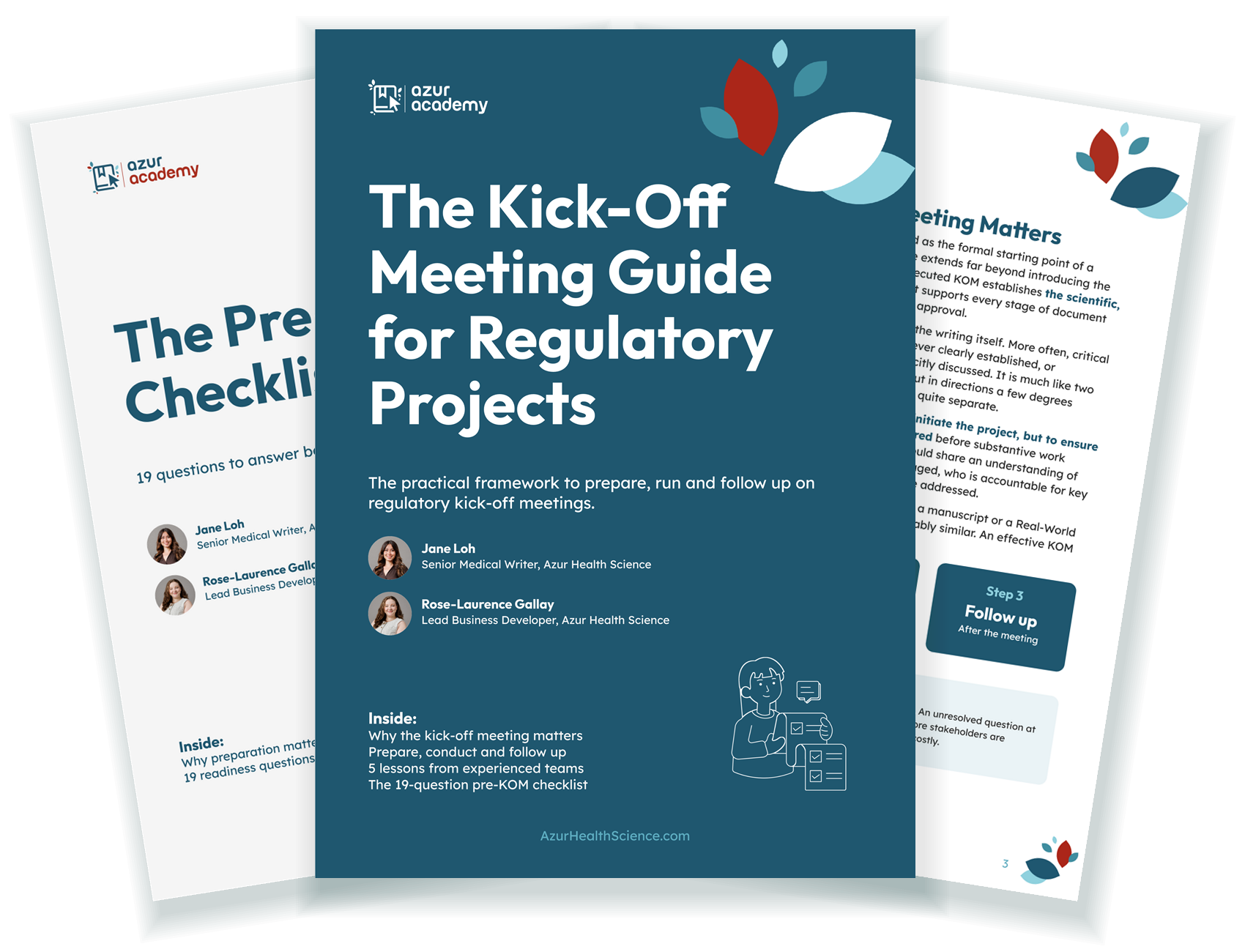
Prepare your next KOM with the free guide
Jane Loh and Rose-Laurence Gallay cover the three steps of an effective KOM, five lessons from experienced project teams, the tools to set up (including a governance matrix) and the 19-question Pre-KOM Checklist.
About the authors

Jane Loh
Senior Medical Writer, Azur Health Science
Epidemiologist and regulatory medical writer with an MSc in Population & Public Health. She works end-to-end on clinical programmes with complex data and small populations, from study design and data interpretation to publication-ready writing.

Rose-Laurence Gallay
Lead Business Developer, Azur Health Science
Rose connects pharma, biotech and CRO partners with the medical writing and consulting expertise they need, building long-term partnerships across Europe and international markets.