A regulatory document can be scientifically sound and still arrive late, after review rounds nobody planned for and comments that contradict each other. When teams look back, the cause is rarely the writing. It is usually something that was never quite decided at the start. That is why the kick-off meeting deserves more attention than it usually gets.
More than a formal starting point
The kick-off meeting (KOM) is often regarded as the formal starting point of a regulatory project. In practice, however, its importance extends far beyond introducing the project team or reviewing timelines. A well-executed KOM establishes the scientific, operational and governance framework that supports every stage of document development, from the first draft through final approval.
Projects rarely become challenging because of the writing of the document itself. More often, delays and inefficiencies arise because critical decisions were deferred, team responsibilities were never clearly established, or assumptions remained implicit rather than explicitly discussed. Although these issues may appear minor during project initiation, they frequently emerge later as extended review cycles, conflicting stakeholder feedback, scope expansion or avoidable rework. Much like two people starting a journey from the same point, but in directions a few degrees apart: with time, they reach destinations that are quite separate.
The purpose of a KOM is alignment
The purpose of a KOM is therefore not simply to exchange information: it is to establish alignment. By the end of the meeting, every participant should have a shared understanding of not only what will be delivered, but also how the project will be managed, who is accountable for key decisions, and how risks and emerging issues will be addressed throughout the project lifecycle.
Although every organisation has its own governance processes, the principles underpinning an effective KOM remain remarkably similar. Whether supporting the development of a Clinical Study Report (CSR), manuscript, Real-World Evidence (RWE) report or another scientific document, successful projects begin with the same objective: establishing sufficient scientific, operational and procedural alignment to enable efficient, high-quality document development.

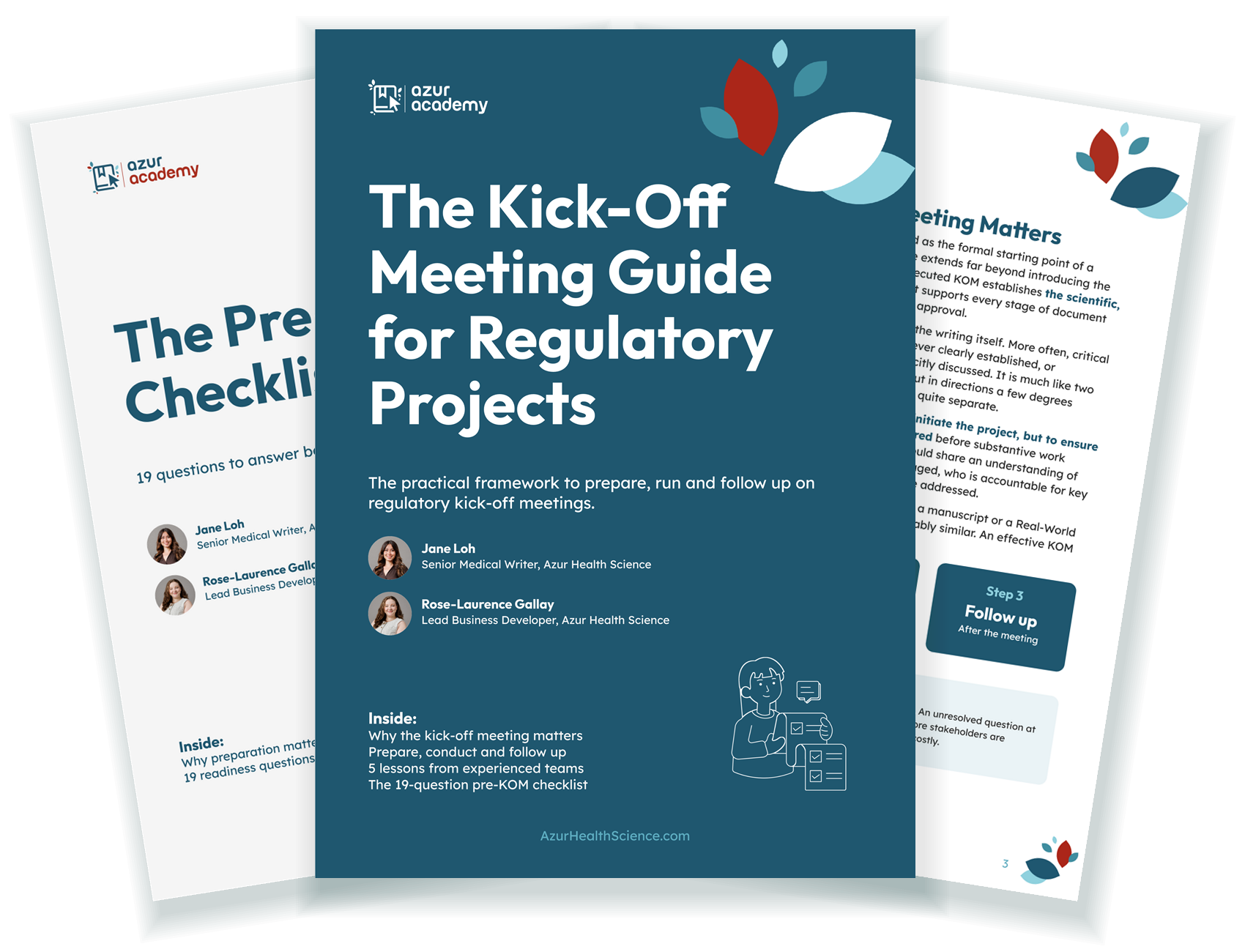
Free guide + checklist: The Kick-Off Meeting Guide for Regulatory Projects
Jane Loh and Rose-Laurence Gallay share a practical framework to prepare, conduct and follow up on your KOM, five lessons from experienced project teams and the Pre-KOM Checklist: 19 questions to answer before your next kick-off meeting.
Why this matters
Many project delays originate long before the first draft is written. An unresolved question during project initiation can resurface weeks later during document review, when more stakeholders are involved, timelines are tighter and implementing changes is significantly more costly. Investing time in a well-planned KOM enables project teams to identify and address these issues while they remain straightforward to resolve, creating a stronger foundation for the work that follows.
Preparation begins before the invitation is sent
An effective KOM is rarely the result of a well-facilitated discussion alone. Rather, it reflects the quality of the preparation that precedes it. The discussions that take place (and the decisions ultimately made) are only as effective as the information available to participants before the meeting begins.
When stakeholders arrive with different versions of key documents, incomplete background information or differing assumptions about project objectives, valuable meeting time is often spent establishing context rather than making decisions. Conversely, thoughtful preparation allows the discussion to focus on resolving uncertainties, confirming expectations and identifying risks while they remain straightforward to address.
Preparation should therefore begin with a simple question: “What information does the team need in order to make informed decisions during the KOM?”
Decide who decides
Many project delays are not caused by scientific complexity but by uncertainty surrounding ownership and decision-making.
Before the KOM, consider who will be responsible for key project activities, including scientific oversight, document development, review, approval and final decision-making. Clarifying these responsibilities in advance allows the meeting to focus on governance rather than ownership and provides a clear framework for managing reviews, resolving conflicting feedback and escalating issues when necessary.
Experienced teams recognise that governance is most effective when it is established before drafting begins rather than developed in response to challenges later in the project.
Conclusion
A kick-off meeting can easily become a formality: introductions, a timeline, a few slides. Treated as the moment when the team aligns on objectives, ownership and risks, it becomes the foundation of the whole project.
Ultimately, the effectiveness of a KOM should not be measured by the quality of the meeting itself, but by the quality of the project that follows.
Get the complete framework, free
The Kick-Off Meeting Guide for Regulatory Projects follows the three steps of a KOM (prepare, conduct, follow up), with the outputs to aim for at each step, the tools to set up and the 19-question Pre-KOM Checklist as a stand-alone PDF to share with your team.
About the authors

Jane Loh
Senior Medical Writer, Azur Health Science
Epidemiologist and regulatory medical writer with an MSc in Population & Public Health. She works end-to-end on clinical programmes with complex data and small populations, from study design and data interpretation to publication-ready writing.

Rose-Laurence Gallay
Lead Business Developer, Azur Health Science
Rose connects pharma, biotech and CRO partners with the medical writing and consulting expertise they need, building long-term partnerships across Europe and international markets.