
Every regulatory team has expert reviewers. Yet many documents still go through more review rounds than planned, with comments that contradict each other and decisions reopened at the last minute. The problem is rarely the people. It is the way review is organised.
A familiar scenario
Imagine the following scenario: a clinical study report is on a critical submission timeline; the first draft is sent to a large global reviewer group across regulatory, clinical, safety, statistics and regional teams; comments return late and conflict with each other; some reviewers focus on wording, others question the interpretation of the primary endpoint, and one senior stakeholder raises a major concern that should have been resolved before drafting began. What project manager, medical writer or project lead hasn’t been in this sort of situation at least a few times in their career? Then the project’s medical writer must spend days reconciling comments, meetings are scheduled to resolve disagreements, and the finalisation date slips.
Unfortunately, such a situation is not as uncommon as one might imagine. In general, it happens because the review has not been designed as a structured process. The solution is not simply “more review”. The solution is better review.
Document review usually fails not because teams lack expertise, but because the process does not make the best use of that expertise. A group of highly experienced reviewers can still produce an inefficient review if roles, expectations, timing and decision ownership are unclear.
Too many reviewers, not enough accountability
Many organisations respond to document risk by involving more reviewers. This is understandable: important documents need expert input, and teams want to avoid missing critical regulatory, clinical, safety or data issues.
However, more reviewers do not automatically mean a better review. When reviewer groups are too large and responsibilities are unclear, review becomes noisy, generating more heat than light. Everyone is invited to comment, but no one is clearly accountable for specific decisions.
A document may appear well reviewed because many people commented on it. However, if accountability is unclear, it may still be uncertain who confirmed the scientific interpretation, regulatory positioning, data accuracy, safety messaging or final approval.

Free guide: Best Review Practices for Regulatory Documents
Socrates Lopez Noguerola, PhD, shares 7 principles of effective review, a 5-stage review model, a reviewer responsibility matrix and 4 ready-to-use checklists and templates.
Strategic issues discovered too late
One of the most damaging review problems is the late discovery of strategic issues. These are not simple wording or formatting problems. They are fundamental questions about what the document is saying, how the data are interpreted, and whether the content supports the intended regulatory objective.
These issues should ideally be addressed before full drafting begins or during an outline or early draft review. When they appear during late-stage review, they can trigger major rewriting, delay approval and affect related documents.
Review is not only an editorial process. It is also a strategic alignment process. If strategic alignment is not achieved early, the review process becomes the place where unresolved clinical, regulatory, safety or development questions emerge.
Inconsistencies across the submission package
Regulatory documents very rarely stand alone. A clinical study report may inform a clinical summary. A clinical summary may support a clinical overview. Without a strong review process, inconsistencies can easily appear across the submission package.
Some inconsistencies may seem minor, but they can reduce confidence in the overall evidence package. Health authorities expect a coherent and reliable regulatory story. If related documents appear to tell slightly different stories, trust erodes, avoidable questions are raised and additional clarification work is requested.
Conclusion
Effective review of regulatory and medical writing documents is not achieved by adding more reviewers or more review rounds. It is achieved by designing a clear, stage-based, role-based review process that brings the right input at the right time.
In practice, that design starts before the first draft: deciding what each review round is for, who reviews what, and who has the final word when comments conflict.
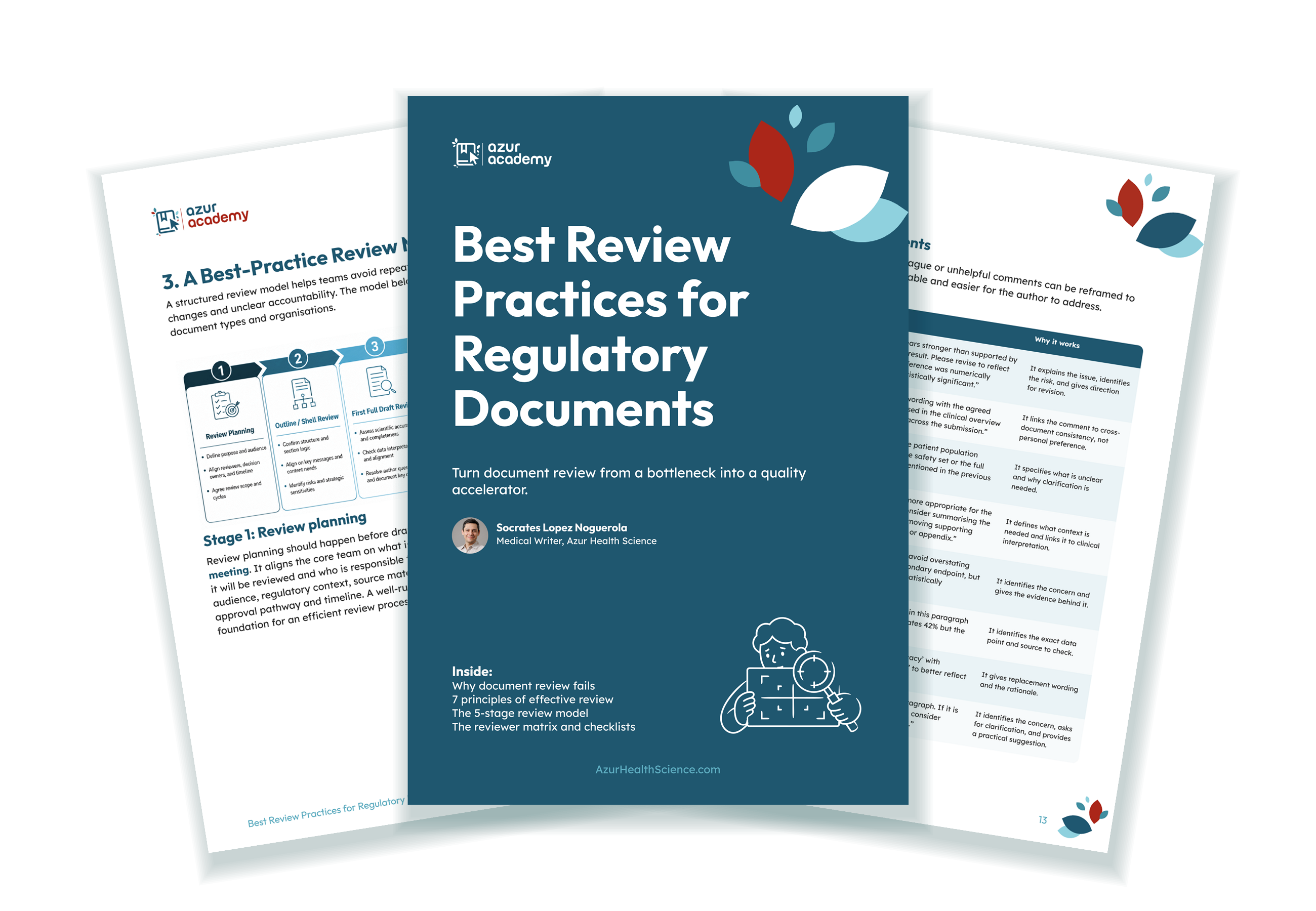
Design a better review process, free
Best Review Practices for Regulatory Documents (17 pages) gives you the 5-stage review model from planning to final approval, the reviewer responsibility matrix, weak vs better comment examples and 4 checklists and templates to use on your next document.
About the author

Socrates Lopez Noguerola, PhD
Medical Writer, Azur Health Science
Medical and regulatory writer, PhD in Neuroscience, with a decade of experience across Germany, Mexico and France. His work spans CTD modules, CSRs, protocols and lay summaries. Member of the European Medical Writers Association (EMWA).